
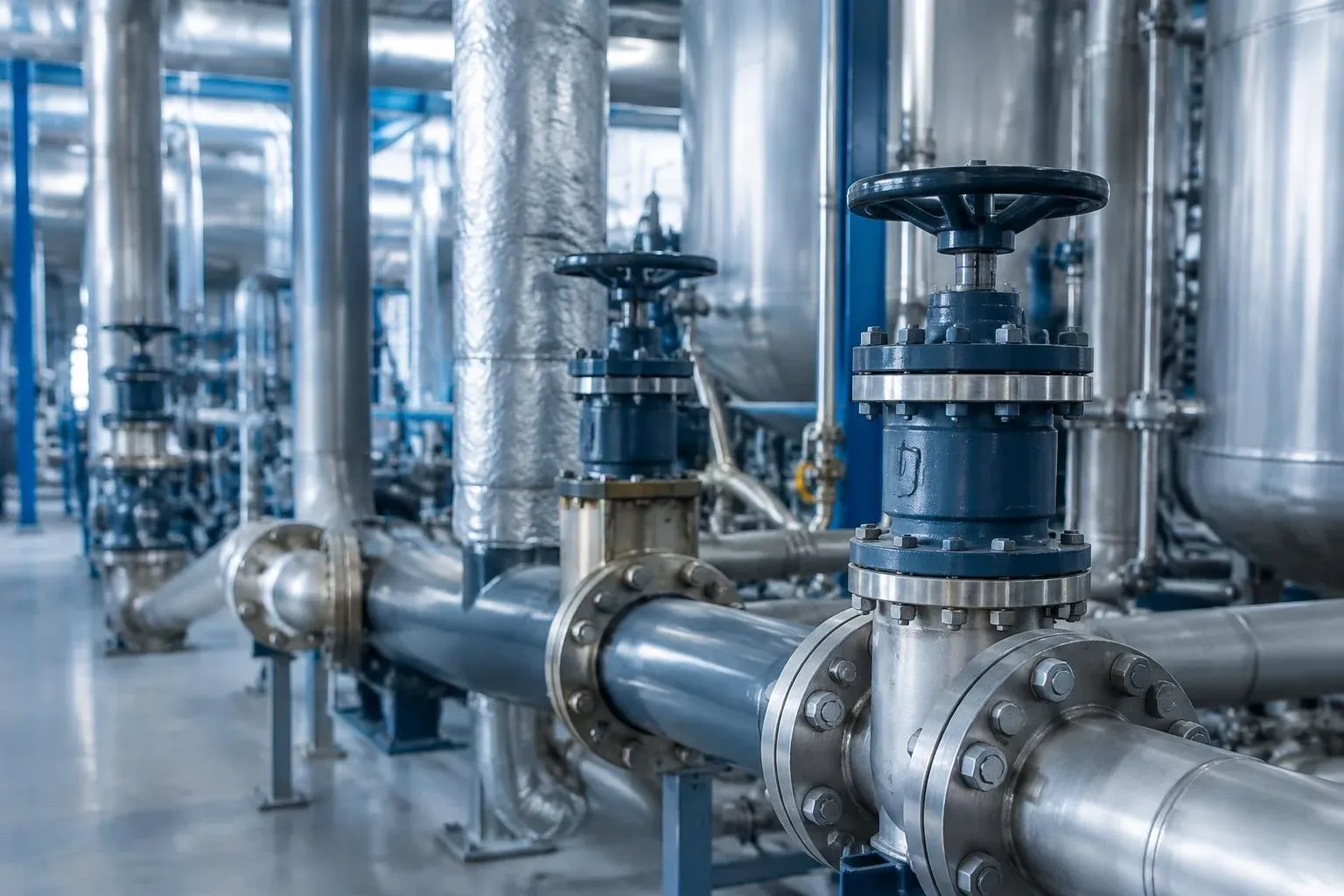
What are PFA and FEP lined valves?
PFA (perfluoroalkoxy) and FEP (fluorinated ethylene propylene) are fluoropolymers used to provide chemical-resistant surfaces.
In a lined valve, the lining separates the process fluid from the underlying valve body, helping protect it from direct chemical exposure.
A lined valve is therefore different from an unlined metallic valve, where the process fluid comes into contact with the body material.
Both PFA and FEP can be suitable for a wide range of corrosive chemicals. However, their performance limits and suitability depend on the application.
PFA vs FEP: What is the difference?
Material Comparison Matrix
| Factor | PFA lining | FEP lining |
|---|---|---|
| Chemical resistance | Broad resistance to many aggressive chemicals | Broad resistance to many aggressive chemicals |
| Temperature capability | Generally higher material temperature capability | Generally lower than PFA |
| Processing | Melt-processable fluoropolymer | Melt-processable fluoropolymer |
| Common consideration | More demanding temperature requirements | Applications within FEP's operating limits |
| Final selection | Depends on valve design and service conditions | Depends on valve design and service conditions |
The important point is that the properties of the lining material do not automatically determine the allowable operating conditions of the complete valve.
The valve body, lining thickness, sealing components, pressure rating and manufacturing design must also be considered.
When should you consider PFA lined valves?
PFA lined valves are often evaluated for chemical applications where both corrosion resistance and elevated temperature capability are important.
They may be considered for certain chemical transfer, process isolation and handling applications involving aggressive media.
However, it would be incorrect to assume that a PFA lining is suitable for every chemical at every temperature.
Chemical concentration, operating pressure, temperature, permeation behaviour and potential mechanical damage all influence suitability.
For demanding service conditions, engineers should confirm the complete valve's rated operating limits with the manufacturer.
When can FEP lined valves be a suitable option?
FEP lined valves can also provide strong chemical resistance in appropriately selected applications.
They may be considered where the operating conditions remain within the lining and complete valve assembly's limits.
For some projects, FEP may provide a practical alternative to PFA.
But the decision should not be based on lining material alone.
Two valves with different designs, lining methods and sealing arrangements may perform differently even when both are described as FEP lined.
This is why the technical datasheet matters more than a broad product label.
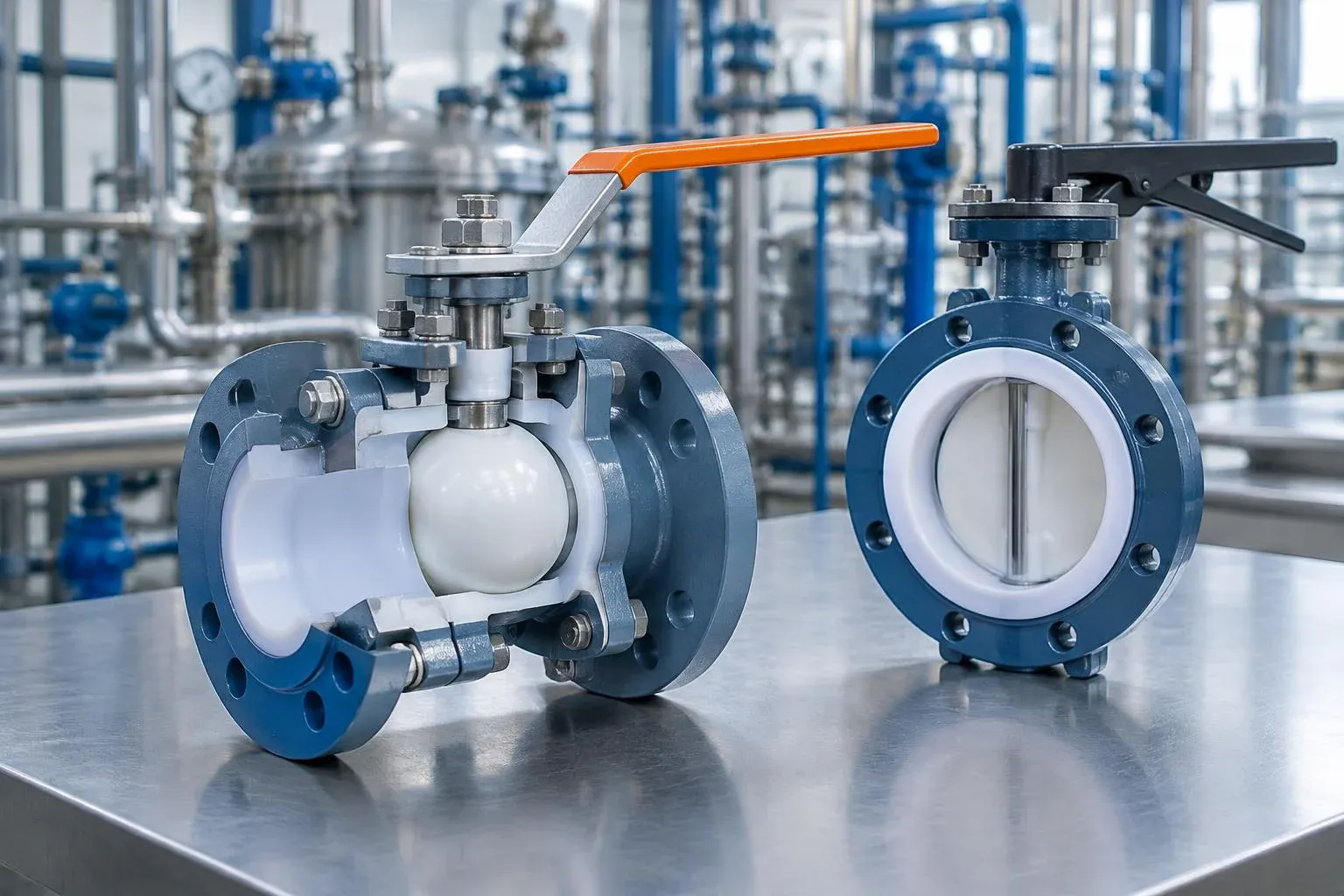
Which valve types are available with chemical-resistant linings?
Several industrial valve designs can be manufactured with fluoropolymer linings.
The correct design depends on the function required in the pipeline.
Lined ball valves
Lined ball valves are commonly considered for on/off isolation duties.
Their quarter-turn operation can make them practical where relatively quick opening and closing is required.
Selection must account for the process fluid, operating conditions, sealing arrangement and compatibility of wetted components.
Lined butterfly valves
Lined butterfly valves may be considered for chemical service in suitable pipeline sizes and pressure conditions.
The valve's disc, liner and sealing arrangement require particular attention because these components can be exposed to the process fluid.
Lined plug valves
Lined plug valves are another option for chemical isolation applications.
Their suitability depends on the valve design, lining construction and service conditions.
Lined check valves
Where reverse-flow prevention is required, lined check valves may be considered.
However, their operating characteristics must also suit the process, including flow conditions and installation requirements.
Five questions to ask before selecting a lined valve
1. What chemical will the valve handle?
Identify the exact chemical rather than describing the fluid simply as acidic or corrosive.
Where relevant, provide details of mixtures and contaminants.
2. What is the chemical concentration?
Chemical compatibility may change with concentration.
A material suitable for a dilute solution may not necessarily be appropriate for a more concentrated process stream.
3. What are the operating and maximum temperatures?
Normal temperature is important, but so are cleaning cycles, process fluctuations and occasional temperature excursions.
The complete valve must be suitable for the specified conditions.
4. What pressure conditions will the valve experience?
Pressure rating, temperature and valve construction must be evaluated together.
Do not assume that every valve using the same lining material has the same pressure capability.
5. Is the valve required for isolation or flow control?
An isolation valve and a throttling valve may require different designs.
Choosing a valve based only on chemical resistance can overlook the actual operating function.
Why the complete valve construction matters
A chemical-resistant lining is important, but it is not the only factor affecting valve reliability.
The lining must remain intact during installation and operation. Seals, interfaces and other wetted components must also be compatible with the process fluid.
For example, a valve with a suitable lining may still be unsuitable if another component exposed to the fluid cannot tolerate the chemical or temperature.
This is one reason why engineering teams should review the complete material specification rather than relying only on the term "chemical-resistant valve."
PFA and FEP lined valve solutions from AMCO
AMCO Industrial Valves offers PFA/FEP lined valve configurations within its industrial product portfolio.
These include lined ball valves, butterfly valves, diaphragm valves, plug valves and check valves.
For example, AMCO's published PFA/FEP lined butterfly valve specifications include wafer-type configurations, with details on size range, body material, pressure rating and applicable manufacturing and testing standards.
The suitability of each configuration should be confirmed against the specific chemical service.
Looking for a lined valve for your chemical process?
Choosing between PFA and FEP starts with understanding the chemical, concentration, temperature, pressure and operating requirements.
Share your application details with AMCO Industrial Valves to discuss available lined valve configurations and request the relevant technical datasheet or quotation.